Malek Bouali
And Their Children After ThemMalek Bouali, Hacine Bouali’s father, is a Moroccan immigrant, a veteran steelworker, and a man whose authority at home contrasts with the diminished position he occupied at work. He disciplines Hacine harshly, at one point assaulting and confining him, yet later tends him after a near-fatal attack and welcomes him back with visible affection. His story holds these contradictions together: the violence he passes on, the racial hierarchy that constrained his own life, and the tenderness that survives between father and son.
Identity and Work
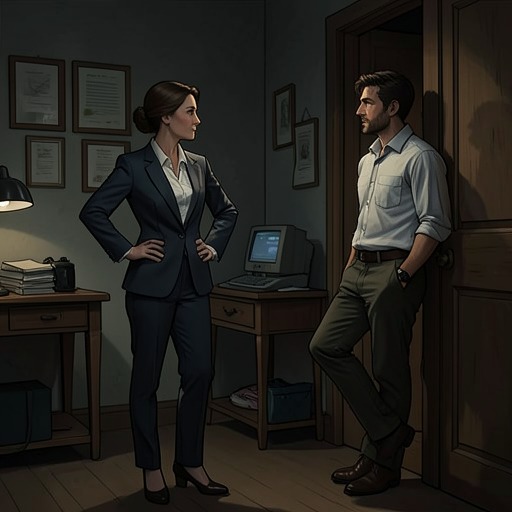
Malek lives in Heillange, where the consequences of migration and industrial labor shape both his family life and his sense of responsibility. By the time Hélène and Anthony visit his apartment in the ZUP Housing Development, he is an aging man dressed in denim, with failing eyesight and a guarded, watchful manner. He initially says little in response to Hélène’s questions about Hacine. When Anthony asks to use the bathroom, the ordinary request gives Hélène an opportunity to explain why she has come: the missing motorcycle and her concern about Hacine. As she speaks, Malek’s expression changes; he feels responsible and old.
That response is bound up with decades of work and subordination. Malek and his wife had emigrated from a poor country and found a measure of refuge in Heillange. He spent forty years taking orders at the steel mill. In his account of the workplace, assignment and advancement did not depend only on competence, seniority, or qualifications: workers were sorted into racialized ranks, with Black and North African workers placed lowest. Even a promotion could not remove the suspicion and contempt directed at men like him. The hierarchy was reinforced by unspoken rules and coercive practices, not simply by the formal demands of production. Malek’s long service therefore brought neither equal standing nor lasting security; it left anger that he had carried for years.
Authority and Violence at Home
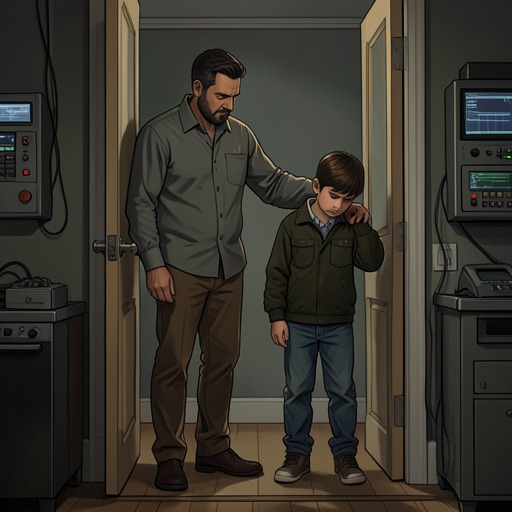
Malek’s relationship with Hacine is marked by repeated threats and punishment. In one early domestic exchange, he asks whether Hacine has smoked again; when his son denies it and asks to come inside, Malek first refuses, then inspects his T-shirt and lets him through. The brief encounter captures a household in which access and trust are negotiated under the father’s scrutiny. Later, after preparing for Hacine’s return by choosing and altering a tool from his basement, Malek waits up for him. When Hacine comes home, Malek strikes him and locks him in his room. In the morning he warns that he will kill his son if he repeats the offense. The narrative establishes the severity of this authority without making its cause fully explicit in that moment; Hacine himself is left trying to understand his father’s anger.
The threat is not a single, self-contained outburst. Years later, Malek again tells Hacine that another failure will cost him his life, but the narration describes the words as heavy and sincere yet emptied by repetition. When police come to the family apartment after the motorcycle affair, Malek faces them with a composed, dignified manner and produces a folder containing his residency and naturalization papers and work contract. The documents attest to decades of accumulated effort and formal belonging, while the police questioning and his son’s detention show how precarious that security remains. Hacine is held for five hours and released; the next day, Malek announces that they are leaving for Tétouan.
Separation and Return
The journey to Morocco is both a family obligation and a strained attempt to set matters right. On an earlier trip, Malek and Hacine travel with a car full of goods for relatives, including coffee, soap, clothes, and jeans to resell. During the ferry crossing Malek cuts Hacine’s hair and gives him new clothes and leather shoes, preparing him to arrive looking presentable. Their family waits on the other side of the Mediterranean, and Hacine’s mother embraces him. Yet the visit also exposes what distance has not repaired: the house Malek has been having built remains unfinished, delayed by workers, permits, and unexpected payments. Its incomplete walls and absent roof stand as a sign of Malek’s prolonged separation from his wife and his failure to supervise the project from France.
When Malek later leaves Tétouan to return to France, he asks Hacine to look after his mother and oversee construction. Hacine promises, although he would rather his father stayed to manage the work himself. The request places responsibility on a son whom Malek has also disciplined through threats. The family’s movement between France and Morocco is not presented as a simple return to safety: men of Malek’s generation had left Morocco in search of work, yet it becomes a place imagined as a remedy for misfortune in France. The unfinished house and Malek’s departure make that promise uncertain rather than complete.
After two years away, Hacine returns to his father’s apartment. Malek opens the door before Hacine can ring and greets him with a broad smile. He has grown more stooped and has begun playing boules with old workmates, a modest routine that gets him outdoors. Inside, he has made harira and bought tea and fresh mint, and he is unusually talkative. He asks whether Hacine will sleep there; Hacine says he is not staying. Their reunion is warm but limited: Malek asks after his wife, whom he already calls every day, and Hacine says she is well. Malek’s grip on Hacine’s elbow reassures his son, a physical gesture that contrasts with the earlier use of physical force. Affection is present, but it does not erase the distance or make the return permanent.
Old Workmates and the Limits of Reconciliation
Malek’s connection with Patrick Casati brings his history at the mill into the family’s present. At Luc Grandemange’s funeral, Patrick recognizes him as a former colleague; the two had worked at neighboring stations until Patrick was assigned to the pour. Their reunion is awkwardly affectionate, filled with questions about health and family and an agreement that it is absurd to live so close without seeing one another. Patrick explains that they had been young together, though he qualifies his nostalgia: those years were not especially good, only earlier ones. He also sees the cost of Malek’s working life in his disability and small pension, and remarks on the pain of watching his children mistreat him.
Their old familiarity does not prevent a later confrontation in court. After Patrick’s assault on Malek, Malek testifies politely and softly. The judge gives him a chance to speak directly to his former workmate, but he says he has nothing to tell him. His silence can look like wisdom; the narration also allows another reading, that he is simply tired. Patrick likewise has no words for Malek. The exchange offers no easy reconciliation: the shared history of labor remains, but neither man turns it into an apology or a renewed friendship.
Care, Departure, and Significance
After Hacine is found badly injured in the men’s room at L’Usine, Malek kneels and takes his son in his arms. At the hospital he visits every day. This care follows the estrangement and punishment that had defined much of their earlier relationship, making his presence a meaningful change without suggesting that their past has been resolved. After the trial, Malek returns to Morocco, this time for good. Hacine later hears a changed, increasingly unfamiliar voice on the telephone and puts off visiting him, afraid to face how much his father has diminished. The distance between them persists even after Malek has shown his devotion at the hospital.
Malek’s significance rests in that unresolved double inheritance. He is not only a father who uses violence, but also a worker shaped by a racialized order that denied him equal standing despite decades of labor. Nor does that history excuse the harm he does at home: the novel keeps the two pressures in view without collapsing one into the other. His tenderness appears in practical acts—preparing his son for a family visit, cooking for his return, gripping his elbow, and sitting beside him in hospital—while his threats and silences mark the limits of what care can repair. Through Malek, migration, work, paternal authority, and aging meet in a relationship that changes, briefly warms, and remains unfinished.